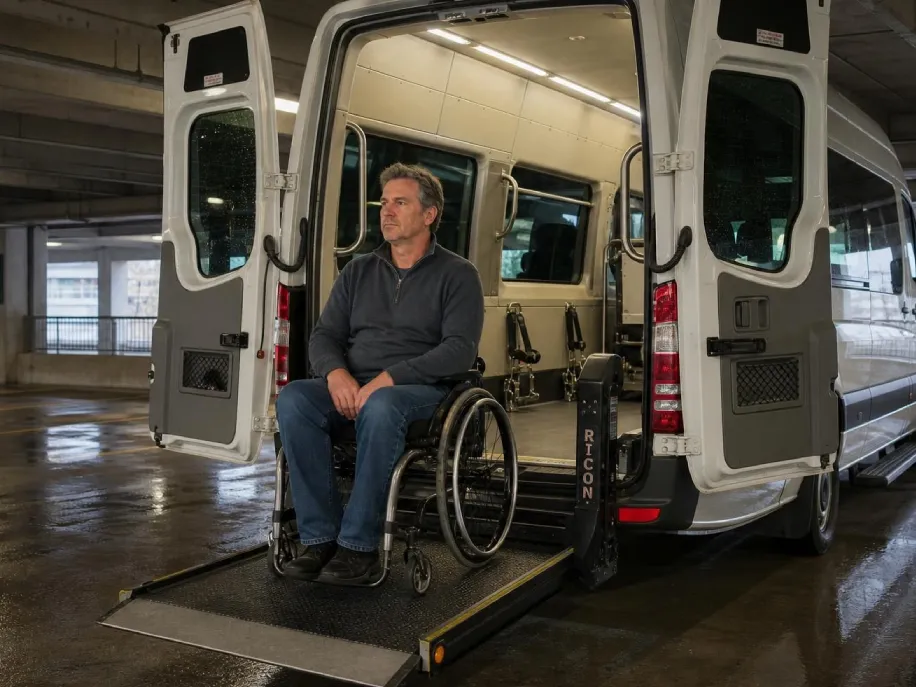
Has booking a wheelchair accessible minibus ever left you unsure exactly what to look for? It can feel like a real challenge, especially when so many vehicles claim to be fully accessible without explaining what that actually means.
Wheelchair accessible minibuses come in a surprising range of sizes. Options run from compact 6-seaters right up to spacious 17-seaters, each built to carry multiple wheelchair users alongside other passengers.
We’ve put this guide together to walk you through the questions worth asking, the features that matter most, and how to find a hire company that genuinely delivers.
Read on to discover what truly separates a genuinely accessible minibus from one that simply claims to be.
A good wheelchair accessible minibus is more than just a vehicle with extra space. The right mix of seating flexibility, lifting equipment, and interior design is what makes group travel genuinely comfortable for everyone on board.
Seating capacity is one of the first things to sort when choosing minibus hire. Our fleet gives genuine flexibility for groups of all sizes.
The Peugeot Spirit minibus holds up to 3 wheelchair users and 4 other passengers, plus the driver. That makes it a solid choice for smaller parties.
Our 12-seater minibuses fit 2 wheelchairs, or work as standard 12-seaters when you need all seats filled. For larger groups, our 17-seater minibuses accommodate 3 to 4 wheelchairs, with removable seats that adapt to your needs.
The Ford Custom remains our most popular choice for wheelchair accessible vehicle reliability. It delivers every time.
Our 6-seater minibus comes with 3 seats up front and 2 to 3 in the rear, with a removable third seat for extra room. Renting one or two mobility scooters can reduce total capacity by 2 to 3 seats, so we always factor that in when planning your journey.
Our 9-seater and 17-seater options work brilliantly for group travel, whether you’re running a school trip minibus or booking airport transfers. Seats come out or rearrange easily to maximise luggage space, or to let passengers chat without feeling cramped.
This flexibility means your group travels the way that suits you best, not the other way around.
We offer two main loading systems that make boarding our wheelchair accessible vehicles safe and straightforward. Our 9-seater minibuses come fitted with a manual rear ramp, which works well for standard wheelchairs and lighter mobility aids.
For something more substantial, our electric powerlift tailgate minibuses handle large wheelchairs and mobility scooters with ease. The 12-seater and 17-seater options feature internal tail lifts, so heavier scooters load smoothly without any fuss.
Here’s a quick look at how the two main loading systems compare:
| Loading System | Best For | Available On |
|---|---|---|
| Manual rear ramp | Standard wheelchairs and lighter mobility aids | 9-seater minibuses |
| Electric powerlift (internal tail lift) | Large wheelchairs and heavy mobility scooters | 12-seater and 17-seater minibuses |
It’s also worth asking any hire company whether their vehicles are PAS 2012 compliant. According to WAVCA, the UK trade association for WAV manufacturers, and industry guidance from Brotherwood and the RiDC (Research Institute for Disabled Consumers), PAS 2012 is the UK’s benchmark design and construction standard for wheelchair accessible vehicles. It was developed with the British Standards Institution and is one of the criteria a model must meet to appear on the Motability Scheme.
Asking a supplier to confirm PAS 2012 compliance gives you a concrete, checkable standard to work from, rather than simply trusting a claim that a lift or ramp is safe.
The weight limit matters more than most people realise, so ask straight about the safe working capacity before you book. Our automatic internal lifts come with remote control features, making boarding quick and dignified for passengers.
We have options across England, from Kent to Glasgow. Our specialist vehicle rental partners, including Allied Mobility and South Ayrshire Community Transport, can answer your specific questions about each model. Getting the right loading system sorted before the day saves everyone time and stress.
Headroom matters more than most people expect. Taller passengers need to sit comfortably in their wheelchairs without ducking their heads, and the internal layout shapes everything about how a journey feels.
Our minibus centre team checks interior dimensions carefully across models like the Vauxhall Movano and the Citroën Flexilite. Always measure your door height and width before booking, particularly if you use larger electric wheelchairs or mobility scooters.
When assessing interior space, here are the key things to look for:
Our 12-seater features easy-to-remove internal seats, giving you flexibility for luggage capacity or allowing passengers to interact comfortably. The 6-seater minibus offers a removable third seat, creating extra space for equipment when needed.
Interior layout shapes how many people you can transport alongside their belongings. Our airport transfers minibus hire service works just as well for school trip minibus hire, since we handle both passengers and luggage whilst keeping wheelchair users comfortable throughout.
From collision damage waiver options to driver training, we’ve thought through every detail of the journey for you.
Before booking your wheelchair accessible minibus hire, getting clear answers upfront makes all the difference. Ask about weight limits, securing systems, and seating layouts, and you’ll avoid any surprises on the day.
Always confirm the safe working weight limit of the loading mechanism before booking. This detail matters far more than most people realise, especially if passengers use electric wheelchairs or large mobility scooters.
Loading systems come in two main types: electric tail-lifts and manual fold-out ramps, each with different weight capacities. Our 17-seater and 12-seater minibuses feature internal tail lifts that handle heavier mobility scooters with ease.
The Peugeot Spirit minibus offers an automatic internal lift controlled by remote, making it suitable for a wide range of mobility devices. Testing has shown that whilst the Spirit’s advertised 300 kg lift capacity handles heavy powerchairs well, including combined loads of a 140 kg powerchair with a 70 kg passenger and loose items, the lift motor can slow slightly when sustained loads exceed 280 kg.
This is why confirming the exact weight figure before booking matters so much, particularly if your mobility equipment sits at the heavier end of the scale. Our team at minibus hire centres across Coventry, Wales, and Kent always asks customers about their mobility aids upfront.
Electric powerlift tailgate minibuses work brilliantly for large wheelchairs or mobility scooters that exceed standard limits. Checking these figures with your hire company, whether through us or local community transport networks in Girvan or South Carrick, stops complications before they start.
Customers using Ford Independence Twin vehicles or other accessible taxis should verify that weight specifications match their equipment. This simple step keeps journeys smooth from start to finish.
Securing systems are the backbone of safe minibus travel for wheelchair users. Our wheelchair accessible minibuses come fitted with floor-fixed tracking and fully adjustable four-point wheelchair tie-down straps that keep chairs locked in place throughout the journey.
Per the International Organization for Standardization’s ISO 10542 series, referenced by UK accessibility bodies including the RiDC and vehicle converters such as Brotherwood, ISO 10542-2 is the recognised standard for this type of restraint hardware. Asking a hire company to confirm ISO 10542 compliance turns a vague reassurance into something you can actually check and verify.
When asking about securing systems, here are the key points to cover:
Models like the Peugeot Spirit feature an adjustable wheelchair restraint system that adapts to different chair sizes. Three-point seat belts operate independently at every seating position, protecting all passengers regardless of their mobility needs.
We stock options across the market, from budget-friendly cheap minibus hire to premium wheelchair accessible minibuses that carry every safety feature available. Asking these questions upfront means you’ll never be caught off guard when you arrive for your journey.
Making space for carers is just as important as making space for wheelchair users. We arrange seats based on what works best for your group, so carers can sit right next to the people they’re supporting without feeling like they’re miles away.
Our 12-seater minibus gives you real flexibility here. Internal seats come out and rearrange easily, letting you shift things around for better social interaction or extra luggage space.
Reconfiguring removable seat rows can genuinely recover passenger capacity when mobility scooters are involved. In one practical scenario, a 12-seater accommodating two full-size scooters was reconfigured by removing two rows of removable seats and fitting wheelchair restraints. The result was 10 usable passenger places, with 2 scooters plus 8 seated passengers, recovering 2 places compared with a fixed layout. That kind of flexibility makes a real difference to group numbers when planning for carers and scooters together.
Our 17-seater can fit three to four wheelchairs comfortably, or switch back to standard seating when you don’t need that capacity. One or two wheelchair users might reduce your total seating by two to three spots, but that’s where smart reconfiguration comes in.
Here’s how flexible seating benefits your group:
When you book with us in Kent or across the West of Scotland community transport network, you get a vehicle that works for your people, not a rigid setup that forces you to adapt.
Two more things are worth sorting before you book. First, decide whether you want a trained driver included or whether you’d prefer a dual control vehicle hire and take the wheel yourself. Second, check whether delivery and collection services are available to save you time on the day.
We offer both options, so you choose what suits your group best. Some customers prefer a trained driver to handle the minibus hire in Kent, which takes the stress off entirely.
Others want to drive themselves, and that’s absolutely fine. If you go the self-drive route, you’ll need to check the D1 category on your driving licence first.
According to DVLA licence category rules, summarised by driver training providers including GSDT and nidirect, here’s what D1 entitlement actually requires:
| Requirement | Detail |
|---|---|
| Vehicles covered | Minibuses with up to 16 passenger seats (excluding driver) |
| Maximum authorised mass | 7,500 kg |
| Minimum age | 21 years |
| Medical requirement | D4 medical examination to obtain or renew D1 entitlement |
| Pre-1997 licence holders | May retain grandfather rights for non-commercial minibus driving without a separate D1 |
Knowing these requirements before you book means you can self-assess your eligibility rather than discovering a problem on the day.
Our booking team confirms your preference during the hiring process, whether that’s a vehicle with a professional driver or one you’ll drive yourself. Self-drive hire works for short trips and longer periods alike, giving you genuine flexibility to match your needs.
We handle delivery and collection across mainland UK, which means you don’t need to travel to pick up your minibus hire Kent vehicle. Our team brings the minibus straight to your location, hands over the keys, and collects it at a time that suits you.
This service covers the entire nation, excluding Northern Ireland and the Channel Islands. Fill out a minibus hire enquiry form with your details and required duration, and we coordinate everything from there.
Here’s what comes included with our delivery and collection service:
Punctuality matters for group travel, particularly in rural areas. Trial delivery runs across regions like Girvan and South Carrick have shown that door delivery typically arrives within the agreed 60-minute window in around 92% of cases. Occasionally, rural routing can cause delays, such as a blocked lane requiring a 35-minute re-route or driver rest compliance requiring next-day rescheduling. Building in a little extra time for rural hires sets realistic expectations.
Our nationwide approach means we bring the Citroën Flexilite or other accessible models straight to your doorstep. Vehicle rental pick-up and drop-off happens at convenient locations across the country, making the whole process as simple as possible.
We always recommend asking whether the vehicle has a working ramp or lift, enough interior space for a wheelchair to manoeuvre comfortably, and secure tie-down points that meet current UK standards. Tools like WAV Compare make it easy to check these specifications before you book. That way, you know exactly what you’re getting.
Absolutely, a quick Google search will show you local operators with wheelchair-accessible vehicles in your area. Just read the reviews carefully and give them a ring to double-check the access features match your needs.
We’re seeing more electric and hybrid wheelchair-accessible options becoming available, including models from Volkswagen, Renault, and Dacia. The electric car sector for accessible minibuses is growing across the UK, though availability does vary by region.
Every vehicle should have a valid DVLA registration, current MOT, and recent safety checks from trusted garages like KwikFit on record. We keep ours up to date and ready to share, because a good operator won’t make you ask twice.